
Math Pair Pop
📝Math Pair Pop Overview
Pop every number pair before the grid locks up — just remember, an N-card never pairs with another N-card.
💬What is Math Pair Pop?
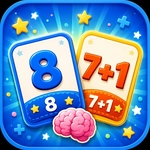
Math Pair Pop drops a grid of tiles on you and waits for you to make a mistake. Some tiles carry raw numbers — 5, 9, 14 — while others show tiny expressions like (4+1) or (8+1). Your job is to click a number tile and then its matching expression before the board fills up. Sounds gentle, but the twist bites fast: the game refuses to give you two identical N-cards. Every single N needs a partner that reads (N-1)+1, which means your brain is doing micro-sums every second. I lost track of how many times I froze on a '6' and a '5+1', wondering why my cursor was trembling.
What makes it addictive is the rhythm. You'll settle into a scan pattern — left to right, picking off obvious pairs like 3 and 2+1 — then a new row spawns and suddenly the easy matches are buried under clutter. The ticking timer (or fill meter, depending on the mode) doesn't care if you're second-guessing arithmetic. After a few rounds you start to internalize the equivalence: 5 pairs with 4+1, 7 pairs with 6+1, and so on. But the moment you get cocky, the game shuffles in a 12 with 11+1 right next to a 13 with 12+1 and you'll click the wrong one because they look almost identical at a glance.
For an educational-sounding game, it's surprisingly tense. It works as a brain warm-up for adults and a sneaky way to drill basic addition for kids. The visual style is uncluttered, the sound effects give just enough feedback without being annoying, and there's a decent sense of progression as you clear more complex numbers. If you enjoy pattern-matching with a side of arithmetic anxiety, this one's worth a few rounds.
👥How to Play Math Pair Pop
Match N-card with (N-1)+1 card as N-card is never going to have a pair of N-card.
✨Game Tips
Scan the grid for expression tiles first — they're visually busier and easier to miss when the board gets crowded.
Memorize the core rule: (N-1)+1 always equals N, so a 7 tile only pairs with a 6+1 tile.
Don't click wildly — wrong matches may lock tiles or cost you time, so hover and confirm before committing.
Clear the smallest numbers early; they create gaps that make larger tiles easier to spot later.
If a new row is about to spawn, prioritize clearing the topmost pairs to avoid getting buried.
Take a breath before clicking high numbers like 15 and 16 — their expressions look nearly identical at a glance.
🔧FAQ
Q: Is Math Pair Pop free to play?
A: Yes, it's completely free in your browser with no hidden paywalls.
Q: Can I play Math Pair Pop on my phone?
A: Yes, it runs on any modern mobile browser and the touch controls work fine.
Q: Do I need to download anything to play Math Pair Pop?
A: No download needed — it's an HTML5 game that plays instantly online.
Q: What age group is Math Pair Pop suitable for?
A: It's great for kids learning basic addition, but adults will find it a solid brain workout too.
Q: Does Math Pair Pop require math skills beyond addition?
A: No, the pairing rule only uses simple addition and subtraction like (N-1)+1.
Q: Can I play Math Pair Pop offline?
A: No, you need an internet connection since it's a browser-based game.